Apple Vision Pro 2 vs. Meta Quest 4: The Smarter Investment?
As the lines between physical and digital workspaces blur, a new generation of spatial computers is coming. We break down the projected costs, performance, and ecosystems to determine which will truly pay dividends for your career.
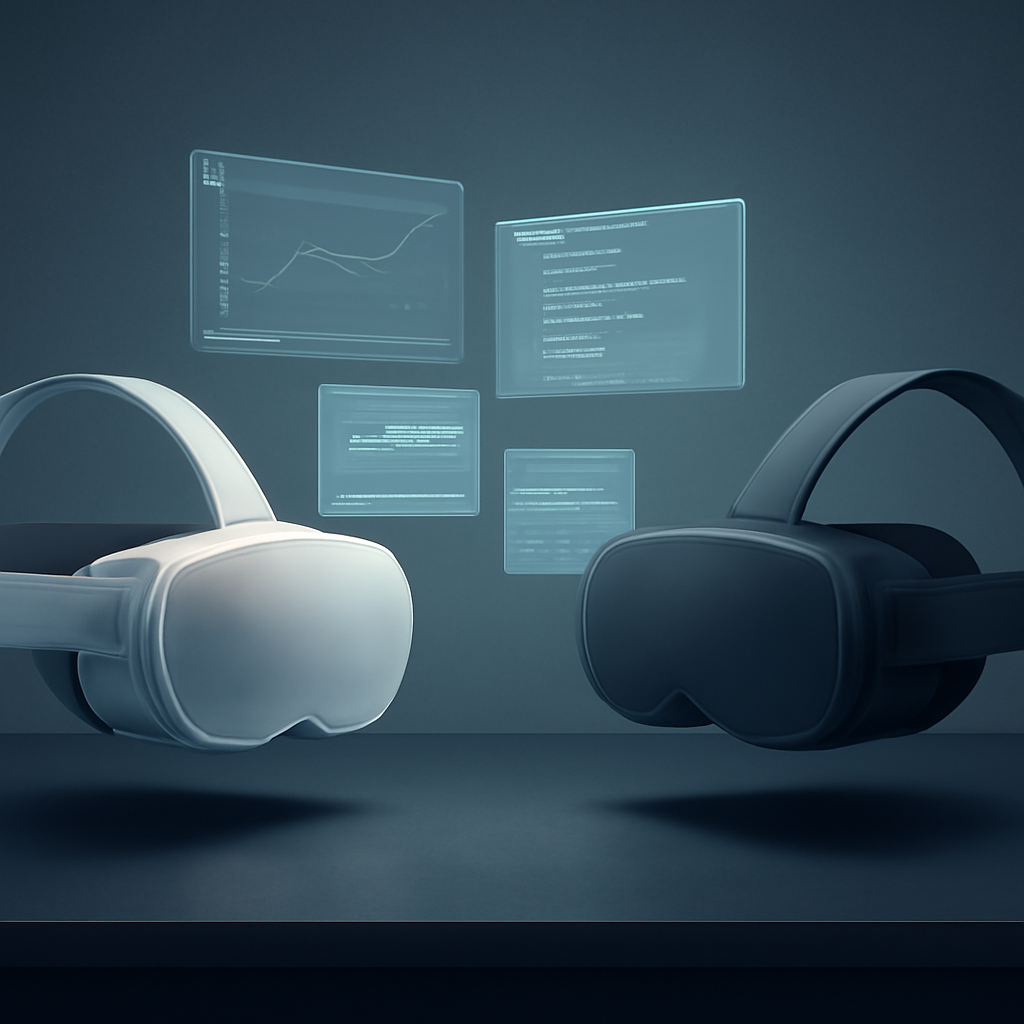
The hum of the server room is gone, replaced by the gentle whir of a device strapped to your head. Your desk is no longer a slab of wood, but an infinite canvas where spreadsheets hang in the air next to 3D architectural models and video calls with photorealistic avatars. In this rapidly emerging reality, the debate over Apple Vision Pro 2 vs. Meta Quest 4 is not just a tech enthusiast's parlor game—it's a critical financial decision for professionals. As we stand on the cusp of spatial computing's next wave, choosing the right headset is an investment in your future productivity, career potential, and financial workflow. This isn't about the coolest new gadget; it's about betting on the ecosystem that will generate the most tangible return.
While neither device has been officially announced, by analyzing the trajectory of the first-generation Apple Vision Pro, the wildly successful Meta Quest 3, and a pipeline of credible industry reporting, we can construct a detailed forecast. This comparison will dissect the two divergent philosophies shaping the future of work to help you decide which platform is the smarter financial bet.
What Are the Core Philosophies of Apple and Meta in Spatial Computing?
Understanding the fundamental difference in strategy between Apple and Meta is the key to predicting their next-generation offerings. Apple employs a top-down, premium-first strategy. It created the most technologically advanced mixed-reality headset possible with the Vision Pro and priced it accordingly, targeting developers and high-end professional users first. The goal is to establish a 'gold standard' for spatial computing and let the ecosystem and price trickle down over time. This is the same playbook they used for the Macintosh and the iPhone.
Meta, conversely, operates on a bottom-up, mass-market strategy. Under the leadership of Mark Zuckerberg, the company’s Reality Labs division has focused on accessibility and scale, subsidizing the hardware of the Quest line to build the largest possible user base. Their recent move to open up their Horizon OS to third-party hardware makers like ASUS and Lenovo doubles down on this ambition, aiming to become the 'Android' of spatial computing. For a professional, this means choosing between a vertically integrated, high-cost but seamless ecosystem (Apple) and an open, lower-cost but potentially more fragmented one (Meta).
| Feature | Apple's Approach (Vision Pro lineage) | Meta's Approach (Quest lineage) |
|---|---|---|
| Target Market | High-end professionals, creators, developers | Mass market consumers, gamers, enterprise |
| Pricing Model | Premium, high-margin hardware | Subsidized, low-margin hardware |
| OS Strategy | Closed, vertically integrated (visionOS) | Open, licensed to partners (Horizon OS) |
| App Store | Curated, high-quality, high-cost | Open, large volume, variable quality |
How Will Display and Passthrough Technology Compare?
The visual experience is paramount for a productivity device meant to be worn for hours. The original Apple Vision Pro set a new benchmark with its dual 4K micro-OLED displays, offering unparalleled sharpness and color fidelity. For the Apple Vision Pro 2, we can expect an iterative but significant improvement. Analyst reports, including those from reliable sources like Ming-Chi Kuo, suggest refinements in brightness and efficiency. The real prize, however, could be a wider field of view, reducing the 'scuba mask' effect of the current generation. The high-fidelity, color-accurate passthrough—which makes it feel like you're looking through clear glass—will undoubtedly remain a core advantage, crucial for blending digital objects with your real-world office.
Meta's Quest 4 will aim to close the gap but will be constrained by its price point. It will likely feature higher-resolution LCD panels than the Quest 3, possibly moving to 'pancake' lenses for a slimmer profile. While its passthrough quality will improve, it is unlikely to match the photorealism of the Vision Pro 2's dedicated R1 chip and superior camera array. For tasks requiring perfect color grading, intricate design work, or a seamless blend with reality, Apple's offering will almost certainly command a premium for a reason. For general office tasks—viewing emails, documents, and participating in virtual meetings—the Quest 4's 'good enough' passthrough will likely be more than adequate.
For professionals whose work is intensely visual—designers, video editors, surgeons—the incremental cost of Apple's superior display technology may be easily justified by efficiency gains and reduced eye strain over thousands of hours of use.
Which Headset Will Offer Better Performance for Demanding Workloads?
Performance is where the two product lines diverge most starkly. The Apple Vision Pro 2 is expected to feature a next-generation Apple Silicon chip, likely a variant of the M4 processor. This desktop-class architecture provides the power to drive multiple high-resolution displays, run complex applications simultaneously, and handle demanding professional software like Final Cut Pro and Logic Pro natively. This is less a headset and more a wearable MacBook Pro, a true spatial computer.
Meta will almost certainly partner with Qualcomm for the Quest 4, utilizing a future Snapdragon XR chipset. While these chips are remarkably efficient and powerful for mobile VR, they are not in the same performance league as Apple's M-series silicon. The Quest 4 will be brilliant for running optimized VR/MR apps, handling Microsoft 365 cloud apps (thanks to Meta's partnership with Microsoft), and multitasking between a few productivity windows. However, it will likely struggle with heavy-duty 3D rendering, complex video edits, or large-scale software development environments running directly on the device. The investment choice here is clear: are you replacing a laptop's power, or augmenting it?
What Does the App Ecosystem Look Like for Productivity on Each Platform?
A powerful machine is useless without the right software. The Apple Vision Pro 2 will benefit from a robust and growing library of native and iPad-compatible apps available through the App Store. Its killer feature is tight integration with the Apple ecosystem. Imagine seamlessly dragging a 3D model from your iPhone into a presentation on your Vision Pro 2, or using it as a massive, private monitor for your MacBook. For professionals already invested in Apple's hardware and software, the synergies will provide an immediate productivity boost.
The most profound shift in productivity won't come from a single killer app, but from the ambient, persistent nature of spatial computing itself—where your workspace is everywhere.
The Meta Quest 4, through its Horizon OS, is playing a numbers game. By opening the platform, they are encouraging a wider variety of apps at all quality levels. Its key advantage for productivity is its deep partnership with Microsoft. The ability to access Windows 365 Cloud PCs, the full Microsoft Office suite, and Teams in a virtual environment is a massive draw for enterprise clients. This makes the Quest 4 a potentially easier and cheaper device to deploy at scale within a corporate environment that runs on Microsoft's stack.
Productivity App Ecosystem at a Glance
| Category | Apple Vision Pro 2 Ecosystem | Meta Quest 4 Ecosystem |
|---|---|---|
| Native Pro Apps | High potential for ports of Final Cut, Logic, Xcode | Limited; focused on VR-native tools like Gravity Sketch |
| Office Suite | Native Microsoft 365 apps, iWork suite, Google Workspace | Deep integration with Microsoft 365, including Windows 365 |
| Collaboration | FaceTime with Spatial Personas, powerful third-party apps | Meta Horizon Workrooms, Microsoft Teams Immersive Spaces |
| Device Synergy | Unmatched integration with Mac, iPhone, and iPad | Limited; primarily PC-link for high-end VR gaming/dev |
What is the Projected Price and Total Cost of Ownership?
This is the bottom line for any personal finance decision. The Apple Vision Pro 2 will be a premium product. Given the first model's $3,499 starting price and expensive components, it's reasonable to project the second generation will land in a similar $3,000 - $4,000 range. Add-ons like prescription lens inserts, a travel case, and potentially a more comfortable head strap could push the total investment closer to $4,500. This is a significant capital expense, comparable to a high-end professional workstation.
Conversely, the Meta Quest 4 is expected to follow the Quest 3's pricing strategy, likely landing in the $500 - $700 range. While Meta may offer a 'Pro' version for more, the base model will prioritize affordability. The total cost of ownership is substantially lower. For this price, you could outfit an entire team of five with Quest 4s for the price of a single Vision Pro 2. This cost differential is the single most important factor for many potential buyers and businesses.
Which Platform Provides a Better Return on Investment (ROI) for Professionals?
Calculating the ROI on a spatial computer is not straightforward, but we can frame it by user profile.
For an independent creative professional—a 3D artist, architect, or video producer—the Apple Vision Pro 2 could deliver a significant ROI. If the device shaves hours off complex rendering or editing tasks, its high upfront cost could be recouped within months. The seamless workflow within the Apple ecosystem is a powerful catalyst for efficiency. For these users, time is money, and the Vision Pro 2 is a tool designed to save them time at the highest level.
For a corporate manager, remote team, or small business owner, the Meta Quest 4 likely presents a more compelling ROI. Its low cost allows for scalable deployment. The value isn't in raw processing power, but in enhanced collaboration. Immersive virtual meetings, collaborative 3D whiteboarding, and access to cloud-based productivity apps can improve team cohesion and innovation at a fraction of the cost of Apple's solution. It’s an investment in communication and workflow, not just individual output.
Ultimately, the choice between the Vision Pro 2 and Quest 4 is a strategic one. Apple is selling a powerful, personal spatial computer to replace or augment your Mac. Meta is selling an accessible portal to collaborative virtual workspaces and the metaverse. One is an investment in personal peak performance; the other is an investment in scalable team connectivity. Before you invest, don't just ask which is better—ask which future of work you are building towards.
“The choice isn't just about pixels and processors; it's a strategic bet on a future of work.”
Frequently asked questions
- Will the Apple Vision Pro 2 be cheaper than the first one?
- It's unlikely. Most analysts predict the Vision Pro 2 will maintain its premium price point, likely between $3,000 and $4,000. Apple's strategy is to establish the high end of the market first before potentially introducing a cheaper, non-Pro model in the future.
- Can the Meta Quest 4 be used for serious work?
- Yes. Through a deep partnership with Microsoft, the Quest platform supports Microsoft 365 apps, Windows 365 Cloud PCs, and immersive Teams meetings. While not as powerful as a Vision Pro, it's a very capable device for mainstream corporate and productivity tasks.
- Do I need a Mac to use the Apple Vision Pro 2?
- While it will be a powerful standalone computer, the Vision Pro 2's biggest productivity advantage comes from its seamless integration with the Mac, allowing it to function as a massive, private external display. You'll get more value from it if you're in the Apple ecosystem.
- When are the Apple Vision Pro 2 and Meta Quest 4 expected to be released?
- Neither company has announced official dates. Based on industry patterns and rumors, the Meta Quest 4 could arrive in late 2024 or 2025, while the Apple Vision Pro 2 is generally not expected before late 2025 or 2026.
- Which headset will be more comfortable for all-day use?
- Both companies are focused on improving ergonomics. The Vision Pro 2 will likely aim to be lighter than the first model. The Quest 4 will benefit from a mature third-party accessory market for custom head straps, which can significantly improve long-term comfort.